
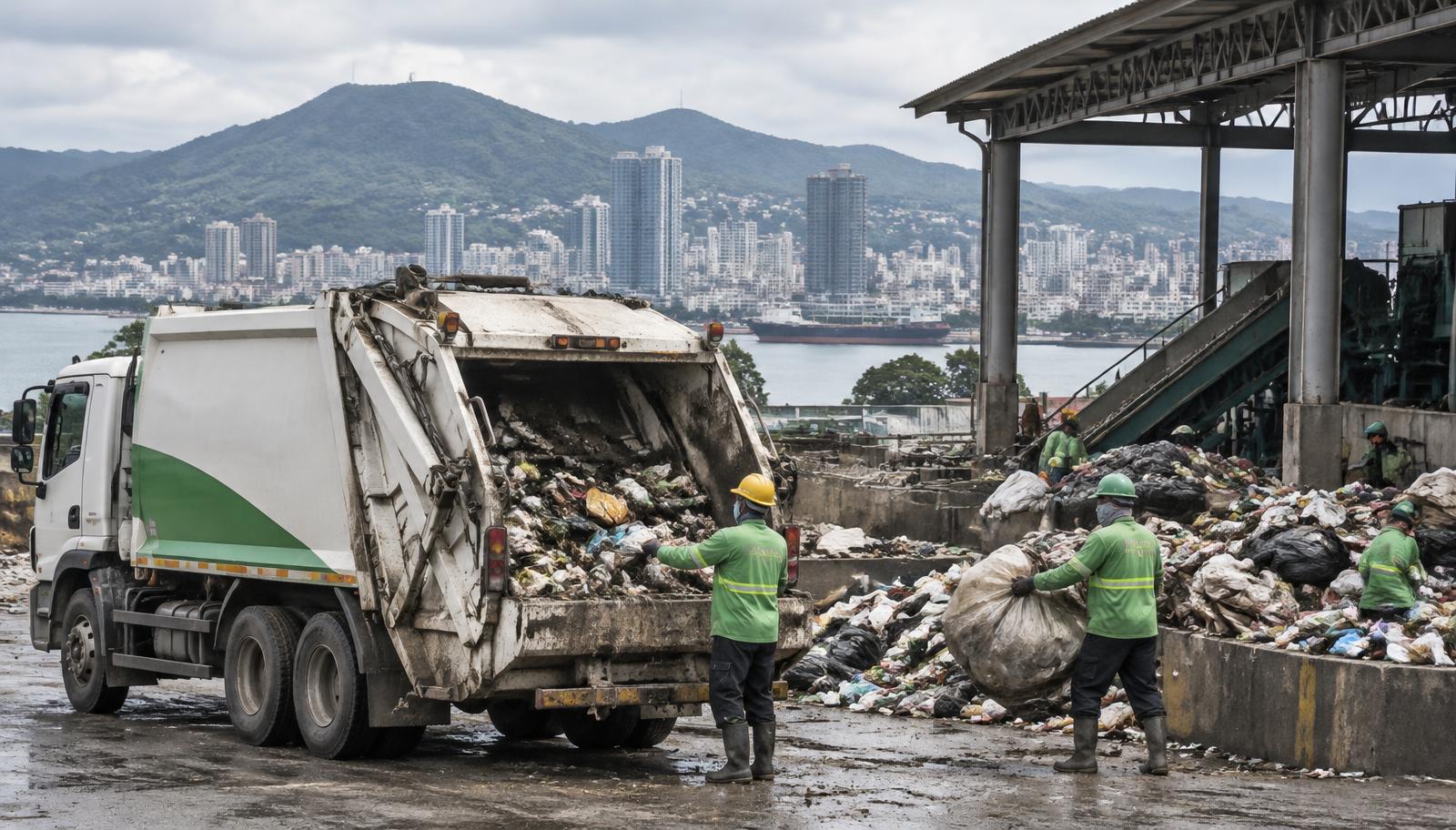
On 29 September 2026, the Cebu City Council is set to consider two developments that are closely connected but should not be treated as the same thing.
The first is a Letter of Intent (LOI) from Suki Trading Corporation proposing an approximately ₱470-million mechanical waste-processing system.
The second is a directive associated with Councilor Harold Kendrick Go requiring the Executive Department to submit, within 15 days, a Comprehensive Solid Waste Financial and Operational Sustainability Report.
One is a vendor proposal.
The other is a demand for financial and operational visibility.
For cities facing landfill constraints, that distinction matters. Before an LGU decides whether a new technology, facility, or contractor is the answer, it needs to understand exactly how much its current waste system costs—and where those costs actually come from.
The real cost of the post-Binaliw waste system
Cebu City’s waste situation changed dramatically after the 8 January 2026 Binaliw landfill landslide, which killed 36 people and disrupted the city’s primary disposal site.
The city has not returned to using Binaliw as its main daily disposal outlet. Residual waste has instead been hauled to a private facility in Aloguinsan, more than 60 kilometers southwest of Cebu City.
That distance has a significant financial consequence.
Councilor Go, as reported by The Freeman on 28 September, placed the city’s current hauling expenditure at approximately ₱4.2 million to ₱4.5 million per day. Mayor Nestor Archival’s chief of staff, Kenneth Siasar, cited the same daily range in SunStar coverage of the proposed waste-processing system.
Earlier reporting placed the cost at approximately ₱3,906 per ton for the current tip-and-haul arrangement, compared with roughly ₱1,100 per ton when Binaliw was the nearby disposal option.
That difference illustrates an important principle for LGUs:
A waste crisis is also a financial-management problem.
The question is not simply how many tons of garbage a city produces.
The question is: What is the full cost of moving, processing, diverting, and ultimately disposing of every ton?
Current estimates of Cebu City’s waste generation vary. Siasar has recently cited approximately 700 tons per day, with eco-stations diverting around 40–50 tons. Archival has cited a wider range of 700 to 1,200 tons per day.
Whatever the precise figure, the financial magnitude is clear: long-distance residual waste disposal has become a multi-million-peso daily operating expense.
For an LGU, that means every peso spent on emergency hauling is a peso that cannot simultaneously be spent on other public priorities.
Four failed bids—and why that does not mean “no procurement”
The city has also struggled to establish a more sustainable local disposal arrangement.
According to SunStar, four scheduled bidding attempts for a licensed solid waste disposal facility failed to produce a successful award.
Prime Waste Solutions Inc. Cebu was reportedly disqualified on 5 May 2026 because of an expired LGU clearance. Subsequent bid openings on 2 July, 21 July, and 10 September reportedly attracted no participating bidders.
But it is important not to interpret failed bids as meaning the city has made no procurement decisions.
Cebu City procurement records show parallel procurement tracks, including a July posting for a licensed solid waste disposal facility rebid and a September listing involving 50,000 tons of garbage hauling and disposal services.
This distinction is important for public-sector analysis:
A long-term disposal facility can remain unawarded while short-term hauling and disposal services continue to be procured.
The two problems are related, but they are not identical.
Meanwhile, city officials have discussed realigning approximately ₱99 million originally associated with Binaliw toward Aloguinsan operations, as well as a possible ₱100-million supplemental appropriation to cover requirements through the end of the year if the facility gap remains unresolved.
Discussions with Toledo City regarding a potential longer-term disposal alternative have also been reported, but these remain discussions rather than a signed disposal arrangement.
The 15-day report may be more important than the LOI
This is where the Council’s financial and operational reporting requirement becomes significant.
According to The Freeman, the requested report covers:
- Current appropriations and fund status
- Actual operating costs and projected requirements
- Procurement history
- Alternative disposal facilities
- Binaliw rehabilitation status
- Barangay-level performance
- Equipment and fleet condition
- Outstanding liabilities
- The proposed 2027 solid waste management budget
- A five-year sustainability projection
- Risk assessment
- A comparative cost matrix of disposal options
That is considerably more useful than simply asking, “What technology should Cebu buy?”
A city cannot properly evaluate a ₱470-million capital proposal without knowing the baseline cost of the system it is replacing—or complementing.
The Council needs to be able to compare options using the same basic units:
pesos per ton, total annual cost, capital expenditure, operating expenditure, residual waste generated, disposal requirements, environmental compliance, and expected useful life.
That is the value of a comparative cost matrix.
What the ₱470-million LOI actually proposes
According to SunStar and The Freeman, Suki Trading Corporation, through President and CEO Engr. Victoriano Ocon, submitted an LOI proposing an Advanced Waste Solution with Environmental Pollution Control Device 500 (AWS-EPCD500) together with an automatic mechanical garbage segregation machine.
The reported package is valued at approximately ₱470 million.
The proposed system is described as having capacity of up to 700 tons per day, operating on a 20-hour schedule.
The AWS-EPCD500 is described in the terms of reference as a pyrolysis unit rated at 10 tons per hour, with pollution-control equipment including wet and dry scrubbers. The proposal also addresses residual ash and other outputs.
The reported site requirement is approximately 5,000 square meters to one hectare, with South Road Properties mentioned as one possible location.
Commercial terms reportedly include staged payments of 15% / 30% / 35% / 20%, training, and one-year maintenance and warranty provisions. The company has also offered assistance related to permits, furan/dioxin testing, and DOST Environmental Technology Verification.
Suki has cited previous deployments in locations including Lapu-Lapu, Dumaguete, and the MMDA.
These are vendor claims and should be evaluated through the appropriate technical, environmental, financial, and procurement processes.
Most importantly, the LOI itself does not constitute an awarded project.
The Mayor’s Office has endorsed the proposal to the City Council for deliberation. As reported by SunStar, the item remains before the legislative body and is not yet an approved project or awarded contract.
That distinction should remain explicit in any public discussion.
An LOI is not a BAC award.
It is not a Notice to Proceed.
It is not an environmental clearance.
And it is not evidence that the city’s landfill dependency will automatically disappear once a proposed system is approved.
What other LGUs should learn from Cebu
Cebu’s current situation provides a useful framework for other Philippine cities.
The sequence is familiar:
landfill disruption → emergency hauling → rising disposal costs → failed procurement → supplemental funding → proposals for new processing technology.
Other highly urbanized cities could face similar pressures.
The lesson is not that LGUs should automatically choose—or reject—any particular technology.
The lesson is that the financial and operational baseline should come first.
Before an LOI is presented as a solution, LGUs should be able to answer seven questions.
1. What is the full cost of the current system?
Include hauling, tipping fees, fuel, fleet costs, transfer stations, personnel, maintenance, liabilities, and other associated expenses.
The number that matters is not simply the tipping fee.
It is the full cost per ton from collection to final disposal.
2. What procurement stage is each proposal actually in?
LGUs should clearly distinguish between:
LOI → Terms of Reference → Procurement → BAC evaluation → Award → Contract → Environmental compliance → Construction → Commissioning.
These are different gates with different legal and operational implications.
3. What happens to the residual waste?
Mechanical segregation does not necessarily eliminate residual waste.
Processing systems can generate rejects, ash, or other materials requiring further handling or disposal.
Every proposed system should therefore answer:
Where does the residual material go? At what cost? Under whose permit?
4. Are alternatives being compared using the same assumptions?
A proper cost matrix should allow the LGU to compare options such as:
- Long-haul disposal
- Regional landfill arrangements
- MRF expansion
- Composting
- Barangay-level diversion
- Pay-as-you-throw mechanisms
- Mechanical processing
- Thermal or pyrolysis systems
- Other compliant waste-to-resource approaches
The comparison should use consistent time horizons and assumptions.
5. Can diversion actually be measured?
A smart waste system should not measure success only by the number of tons transported.
LGUs should also track:
- Waste segregation rates
- Eco-station diversion
- Recycling recovery
- Composting volumes
- Barangay performance
- Residual waste generation
The objective should be to reduce the amount of waste that requires expensive final disposal.
6. Has the site been evaluated beyond the footprint?
A proposed 5,000-square-meter to one-hectare facility is not simply a land requirement.
The LGU must also consider traffic, emissions, odor, noise, environmental compliance, surrounding communities, logistics, emergency access, and long-term land-use compatibility.
A technically viable facility can still create significant implementation challenges if the site is not appropriate.
7. Does the procurement process remain intact?
A disaster or emergency does not eliminate the need for appropriate procurement, eligibility, environmental compliance, performance requirements, and accountability.
When a procurement fails, the answer may be to improve the procurement package, market engagement, specifications, or project structure—not simply to bypass the process.
The smart-city question
Smart-city thinking is often associated with sensors, dashboards, artificial intelligence, and automation.
But the more fundamental question is simpler:
Does the city have the data to make a good decision?
Cebu’s waste crisis demonstrates why.
Before investing hundreds of millions of pesos in infrastructure, an LGU should know:
- How much waste is generated?
- How much is diverted?
- How much is transported?
- How much does each ton cost?
- Where does it go?
- What remains after processing?
- How much will each alternative cost over five years?
That is the beginning of smart waste management.
The most useful output from Cebu’s current debate may therefore not be a particular machine.
It may be the development of a transparent, comparable, citywide waste-cost model that allows elected officials, administrators, citizens, and potential service providers to evaluate solutions using the same evidence.
For Cebu City—and for other LGUs facing similar pressures—the principle is straightforward:
Put the peso, the tonne, and the residual waste on the same page before choosing the technology.
That is not anti-technology.
It is what responsible technology adoption looks like in a city.