
By Oscar Lopez Jr.
The Philippines does not need to become a gigawatt AI-training hub to matter in ASEAN digital infrastructure. What it needs is clearer: reliable halls for banks, business-process operations, government systems, and cloud on-ramps—plus enough power, fiber, and interconnection to keep those loads in-country.
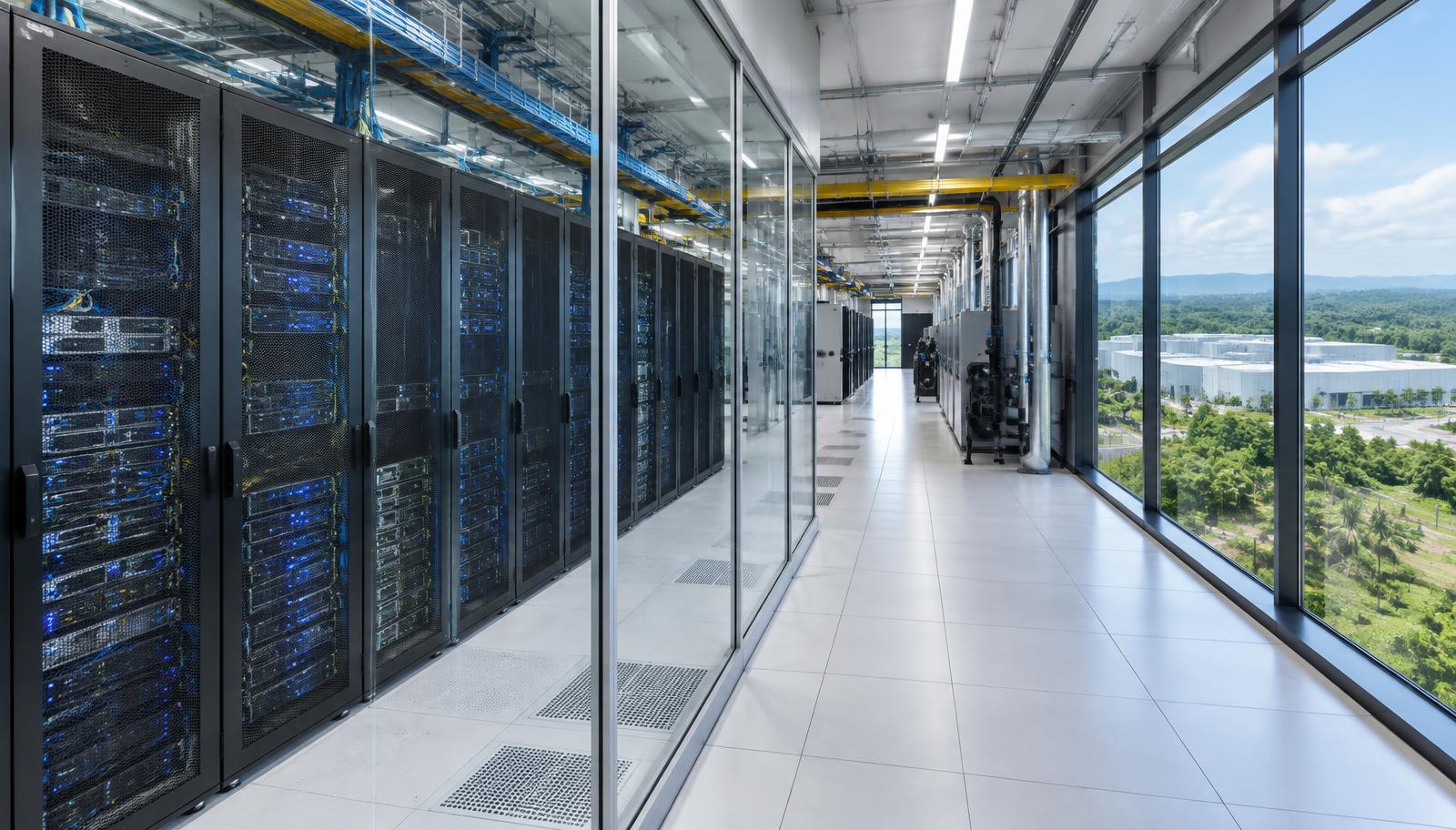
A data center keeps IT running around the clock—compute, storage, networking, power, and cooling—with carrier fiber, internet exchanges, cloud on-ramps, and cable landings linking it to the wider network. Without firm power, cooling, and diverse fiber, servers are expensive furniture.
Fact: As of late September 2026, BMI Country Risk and Industry Research (via TechNode Global) estimated roughly 140 MW of live Philippine capacity across 44 facilities, with about 43 MW under construction and 221 MW planned. Those are research estimates, not a government census—and converting pipeline megawatts into energized halls still depends on grid connections and renewable procurement.
Traditional, colo, and hyperscale—not the same animal
For planners, the useful split is who owns the facility, how big the power envelope is, and who the customer is.
| Dimension | Traditional / enterprise | Colocation (retail & wholesale) | Hyperscale |
|---|---|---|---|
| Typical IT load | Roughly 1–10 MW per site | Mid-single to mid-teens MW per building; campuses grow in phases | Commonly 20–100+ MW per facility; campuses can reach hundreds of MW |
| Ownership | Bank, telco, agency, or corporation for its own IT | Third-party operator leases space, power, and connectivity | Usually owned/operated by a cloud or internet giant—or built to their spec |
| Design priority | Control, compliance, redundancy | Shared resilience plus dense interconnection | Efficiency and speed of scale: modular halls, high density |
| Customers | Internal / regulated on-prem loads | Enterprises, content networks, cloud on-ramps, fintech, government | Cloud regions, large SaaS, AI training/inference at extreme density |
| Efficiency / density (indicative) | Many near ~1.5–1.8 PUE; legacy racks ~3–10 kW | Design PUE often ~1.2–1.4; racks ~8–15 kW, high-density 15–30+ | Fleet PUEs nearer ~1.1–1.2; AI halls may need liquid cooling at 40–100+ kW/rack |
Fact: Power Usage Effectiveness (PUE) is total facility power ÷ IT equipment power. Industry-average PUEs (Uptime Institute survey context) sit well above the best hyperscale fleets—do not equate a marketing “design PUE” with another site’s measured annual PUE.
Interpretation: “Hyperscale” is not a badge for any large building. It usually means cloud-scale economics—standardized design, high utilization, and power/cooling built to expand. A Philippine hall can be hyperscale-capable without being owned by Amazon, Google, or Microsoft.
Adjacent concepts: Edge sites sit near users (payments, gaming, caches, sensors). A public cloud region is a multi–availability-zone footprint—Singapore and Jakarta remain the main ASEAN options for several majors; Local Zones or sovereign colo are not the same. Training chases cheap firm power at huge scale; inference and smaller GPU pods can sit closer to users and regulated data.
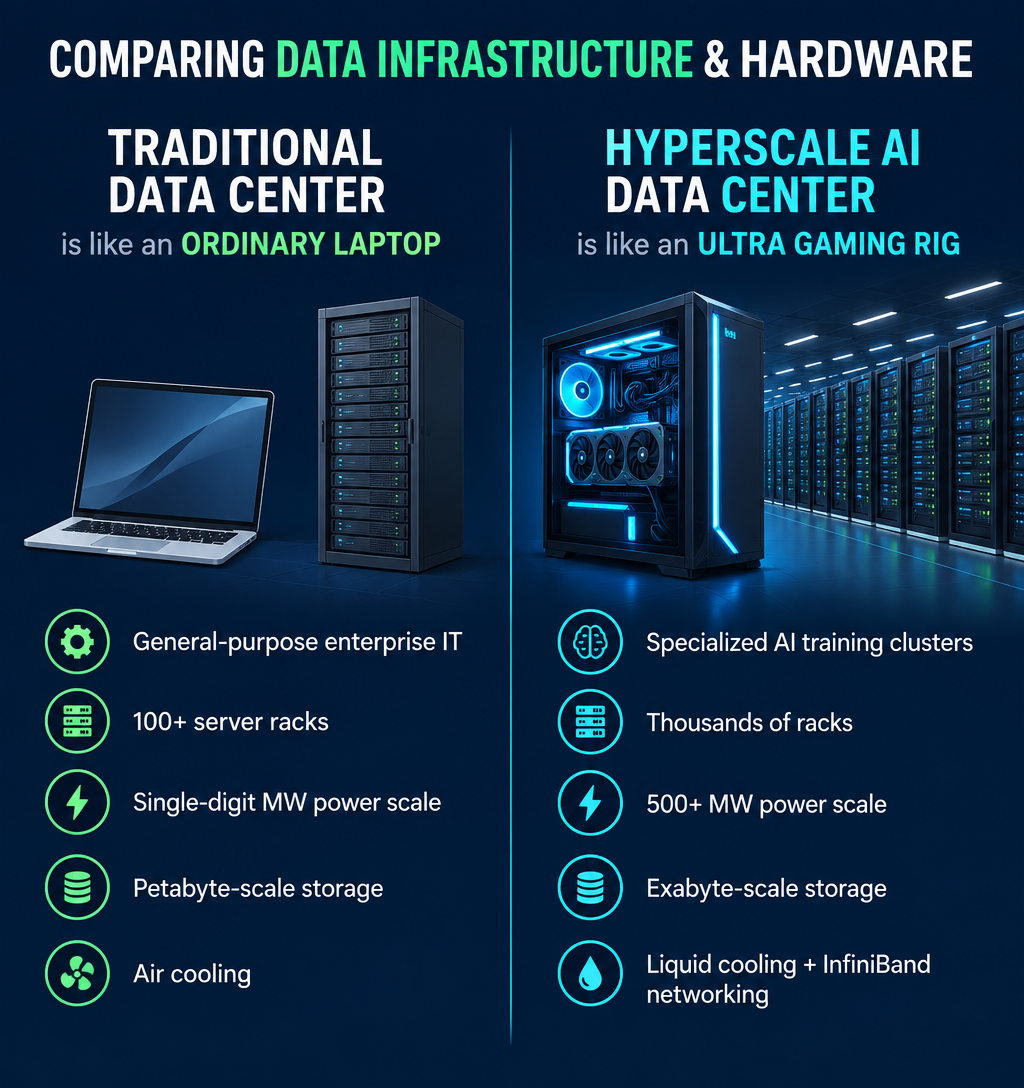
Ordinary Laptop vs Ultra Gaming Rig Analogy
The analogy that a traditional data center is like an ordinary laptop captures the general-purpose, self-contained nature of corporate IT, where the facility is scaled to meet the discrete, standard workloads of a single enterprise.
In contrast, comparing a hyperscale AI data center to an ultra gaming rig emphasizes the extreme specialization and focus on raw processing power, much like a high-end gaming PC is overbuilt with top-tier components specifically for peak performance.
While the laptop analogy highlights general utility and enterprise-level scale, the gaming rig analogy illustrates the shift towards massive, shared, multi-tenant clusters that push the absolute limits of compute capability for specialized tasks like large-model AI training.
What is real in the Philippines
Operating and announced capacity—selected facts
- VITRO (ePLDT / PLDT group). VITRO Santa Rosa (Laguna) is widely cited among the largest operating campuses (~50 MW IT in BMI/operator coverage), marketed as AI-ready. Mid-2026 press also flagged a planned REIT and Cavite / General Trias builds—treat phased MW as announcements until energized.
- ST Telemedia Global Data Centres Philippines (Globe / Ayala / ST Telemedia JV). STT Fairview: carrier-neutral, liquid-cooling-ready campus with full-build IT target near ~124 MW (some briefings cite ~128 MW PH path). Totals are design build-out; mid-2026 coverage put energized Fairview in the low-30s MW.
- Digital Edge NARRA1 (Biñan / Laguna): about 10 MW, ~2,200 cabinets, annual PUE near 1.24 (operator figures); BMI notes a First Gen hydro power-purchase agreement.
- Equinix (Jun 2025): acquired Manila MN1–MN3 from Total Information Management—1,000+ cabinets, interconnection-led entry.
- Watch list: Digital Halo Cainta; A-FLOW ML1 Laguna (initial ~6 MW); YCO Cloud + Aolani’s 10,000+ NVIDIA GB300 cluster targeting Q1 2027 (TechNode / Philstar, late Sep 2026)—MW, site, customers, renewables undisclosed. No confirmed AirTrunk PH facility at research time.
Cloud regions vs local presence
Verified: Amazon Web Services has no full Manila Region; it does have an AWS Local Zone in Manila (ap-southeast-1-mnl-1a) parented to Singapore. Mid-2026 talk of a multi-year AWS investment / Region remains proposal / diligence. Microsoft Azure, Google Cloud, and Oracle public lists still emphasize Singapore and nearby Asia-Pacific sites—not Manila—at research time. Alibaba Cloud operates a Manila region (one AZ from 2021; BMI notes further SEA expansion plans).
Interpretation: Secondary pieces often blur Local Zones, partner colo, or “Cloud for Philippines” marketing with a full region. Ask: named multi-AZ public region, or local interconnection / dedicated hardware?
Policy on the books
Under Memorandum Order No. 47 (2026), the 2026 Strategic Investment Priority Plan (SIPP) lists data centers among activities that can qualify for CREATE / CREATE MORE incentives via the Board of Investments (BOI), the Philippine Economic Zone Authority (PEZA), and other agencies. ASEAN Briefing (1 Oct 2026) summarizes Tier III treatment—confirm against current General Policies. The Department of Information and Communications Technology (DICT) Philippines AI+ Infrastructure Masterplan (PAIIM) 2026–2033 frames ~US$34.4B and a 1.5 GW AI capacity target by 2033 from an ~50 MW AI baseline—a plan, not megawatts at the fence.
Binding constraints
- Power availability and cost. Dominant opex and schedule risk. Eco-Business (Jan 2026) cited industrial tariffs near ~US$154/MWh in 2025—above Vietnam/Indonesia peer narratives; large-user rates can differ. Firm capacity, queues, and a thermal-heavy mix matter as much as the headline. BMI flags grid and permitting risk for converting the planned pipeline.
- Transmission and substations. Hyperscale-class sites need high-voltage feeds and long lead times.
- Land, flood, and typhoon risk. Top-tier disaster-risk exposure raises design and insurance costs.
- Submarine cables and backhaul. Diverse landings—including Bifrost and Apricot branches (e.g. Baler, Digos/Davao)—decide hub vs cul-de-sac; full Apricot service remains phased into 2027 in trade coverage.
- Water, cooling, talent, permits. Liquid-cooled AI halls change plumbing; facilities talent is scarce vs announced MW; multi-agency clearances remain friction.
Realistic Philippine participation lanes
(a) Regional colo and interconnection hubs — carriers, internet exchanges, cloud on-ramps (Equinix, STT Fairview, Digital Edge NARRA1).
(b) Edge for telcos, fintech, gaming, and local government unit (LGU) systems — resilient racks for disaster recovery, payments, analytics, and caches; not every city needs a 50 MW hall.
(c) Government data residency and sovereign-style hosting — in-country storage/processing via local colo, private cloud, or dedicated zones without waiting for a full hyperscaler region. Clarity from DICT, the National Privacy Commission (NPC), and sector regulators matters more than ribbon-cuttings.
(d) Inference pods and mid-scale GPU colo—not gigawatt training — smaller GPU halls (roughly 5–30 MW enterprise/sovereign pods) inside existing colo reuse grid connections and sit closer to users. Frontier AI mega-campuses competing on cheap firm power at hundred-MW / GW scale remain a stretch near-term.
(e) Renewable power parks and local services — co-locate generation, storage, and transmission upgrades; capture construction, M&E, facilities, and security jobs even when the landowner is global.
Interpretation: Sharper Philippine bets are interconnection quality, domestic digital demand, bankable mid-scale campuses, and inference/sovereign pods—not winning the global AI-training land rush on price alone.
Why LGUs should care
Smart-city systems—permits, health records, traffic analytics, early warning—need somewhere trustworthy to run and somewhere else to fail over to. A well-sited colo or edge node can host those loads, create facilities jobs, and anchor fiber. Not every city needs a hyperscale campus. Map hosting needs, protect fiber/substation corridors, require power-availability and flood assessments before rezoning, and size ambition to lanes (a)–(e).
Checklist (short)
National agencies (DICT, Department of Energy, National Grid Corporation of the Philippines / transmission planning, BOI, PEZA, Department of Environment and Natural Resources, NPC): clear SIPP/CREATE MORE rules; align power and transmission with DC corridors; transparent cable-landing maps; separate sovereign hosting requirements from cloud-region cheerleading; pair PAIIM targets with credible generation timelines.
LGUs and ecozones: power letters and geo-hazard assessments before rezoning; protect fiber and high-voltage rights-of-way; prefer interconnection-rich campuses over empty shells; plan water capacity for cooling; edge and colo first—hyperscale only where megawatts and cables already pencil.
Independent explainer for smartcity.ph. Not investment advice; facility MW figures and project timelines change as phases energize.